
It’s not about a tool or a model, but about your expertise and the criteria that will ultimately enable you to generate profound changes in the industry.
Over the last two years, we have witnessed the biggest tech revolution of the century. We have gone through a spiral of company changes, trends, hype, influencers, misinformation, uncertainty, and massive layoffs, to name a few. These behaviors are “expected” somehow when, as a society, we face such a tremendous change in how we create things, communicate with systems and services, and begin to see our reality with new eyes.
The impact of having AI now rooted in our lives has had huge consequences for all of us on many levels. One of these, without question, is the significant influence on businesses that, as any tech revolution does, creates new transactional dynamics between companies, services, and users, as well as new corporate bets that are not always positive for everyone.
Along with this new way of connecting people (or should we start saying agents?) with products and services, there is a phenomenon that has led us to lose the real perspective on businesses and human value. As evidence of this problem, the companies that laid off thousands of people in 2025 because of the benefits of the almighty AI tools now seem to regret that decision due to the high costs of tokens and irresponsible usage of AI models; some companies now put in the balance the cost of expending tokens against the full price of an employee, and the numbers do not match. The new market reality is still evolving every day, so what we can be certain about today might be obsolete tomorrow.
My reading of this phenomenon (without being, or pretending to be, an expert) is a simple graphic illustrating the inverse relationship between technology (in this case, AI) and human skills that can affect industry realities nowadays.
This opposing relationship between humans and tech progress is not new in our history as a society (it is actually part of pop culture, as seen in stories and movies for decades). Still, it doesn’t mean we can’t relate to achieving greater results; that is precisely the point of this article: understanding where the real value to employees lies despite significant technological advancements.
A machine that creates everything?
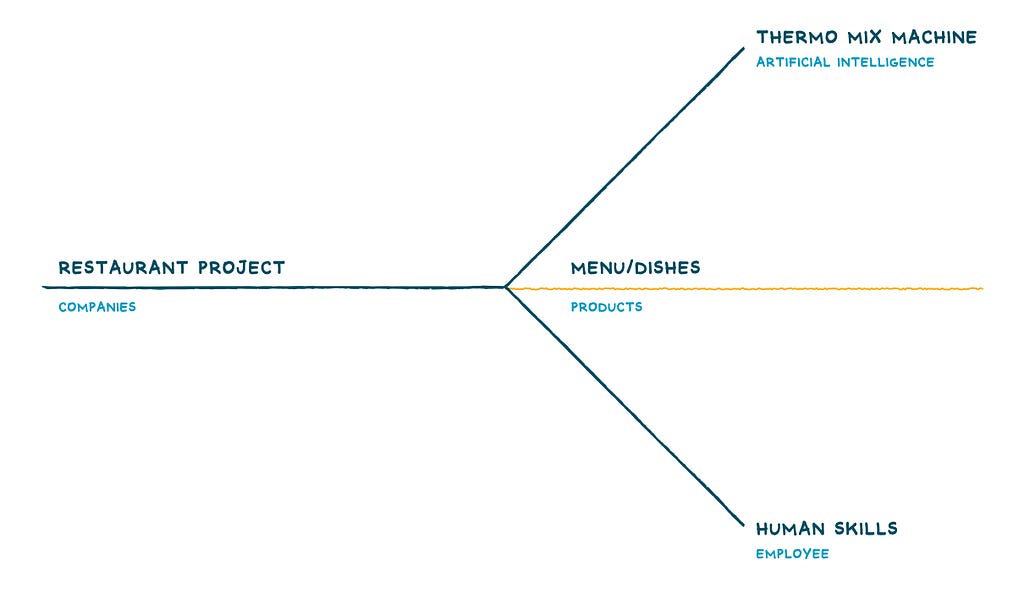
In a conversation with a colleague the other day, he gave me an example illustrating the current situation in companies: the dilemma of choosing between people and technology, or between automation and human skills to thrive in business, and, above all, how to measure whether things are going well.
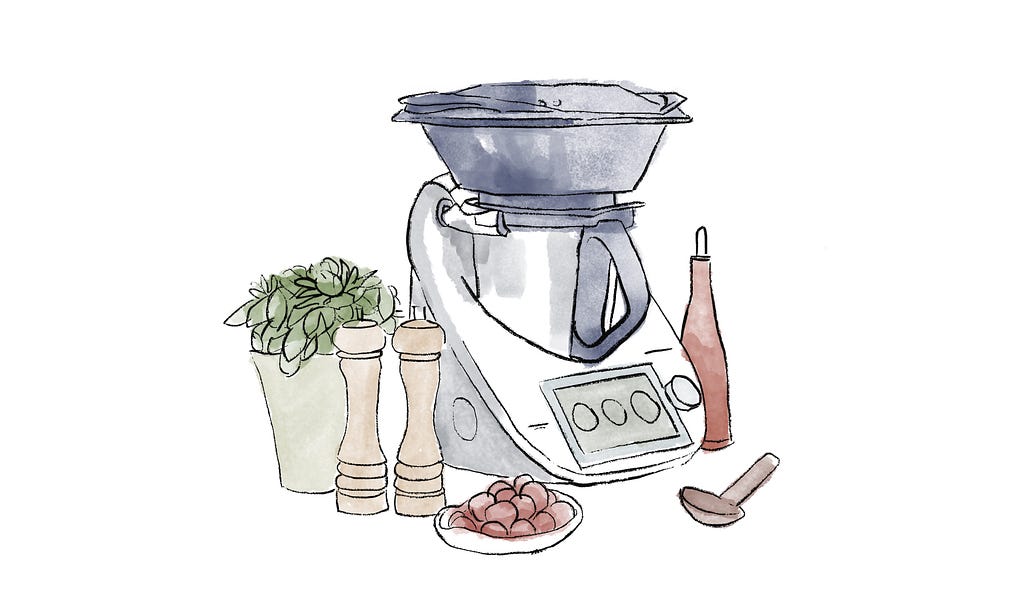
The perfect metaphor he used to illustrate this crossroads goes like this: Imagine you could get the Thermomix machine, a smart cooking robot that can literally cook anything for you, so the problem of learning how to cook would be almost nonexistent, and with this advantage, you decide to start a business around this new toy, seeking to thrive in the food market by being faster and more affordable than competitors.
So far, with this advantage, some considerations will arise when starting a new commercial venture: no need to hire employees; you already have a complete kitchen production in a single artifact. No recipe limitations: you already have an extensive catalog of options to offer without effort, and without the recipe barrier, there’s no need for a learning path to innovate with unique dishes.
Everything sounds promising, doesn’t it? But as usual, nothing in life is granted, and it is always full of nuances. These are the possible scenarios I can predict from that example (not a novelty), which would happen with this situation (I’ll refer to generalities only to illustrate the point):
The all-machine business
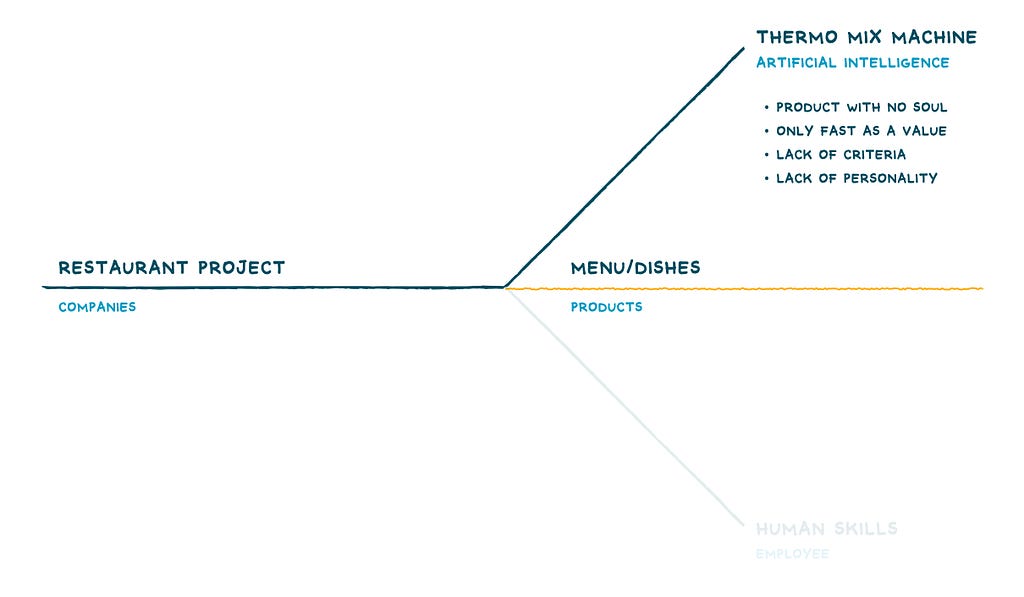
This scenario is pretty much the reality for many companies now; whether big or small, the risk of choosing technology outcomes over human skills can reveal complex challenges as well as benefits. The most evident consequences of this approach might be the following:
Possible positive side:
As a new business, all initial investment will focus on acquiring the thermo machine to get started; once you have that, you will have almost the entire production chain in one place and under your own operation.
All incomes will be yours since you don’t need employees or infrastructure that requires rent. If the business needs customer service, maybe, as a starting point, you can be the same person who operates the machine and delivers.
Possible negative side:
The thermo machine will indeed do the job, and that’s it. For some people, that will be enough, but to make a name in the food market, having the same product value as hundreds of restaurants with more capabilities will not make a difference. How do you compete in this scenario? Maybe use the time factor, but does your food offer something else that will make people come back?
In a vast market of options, having a soul, style, or purpose will make you stand out from others. The same criteria apply to technology: our thermo machine is all the AI models that promise fast results, but they are so generic that anyone can tell the same technology created them, and eventually, our product will vanish and be devalued among hundreds of identical solutions.
Will this business be more profitable if the person who operates the Thermo mix machine could potentially add some strategy to the company beyond just making dishes? My answer is in a few paragraphs.
The all-human business
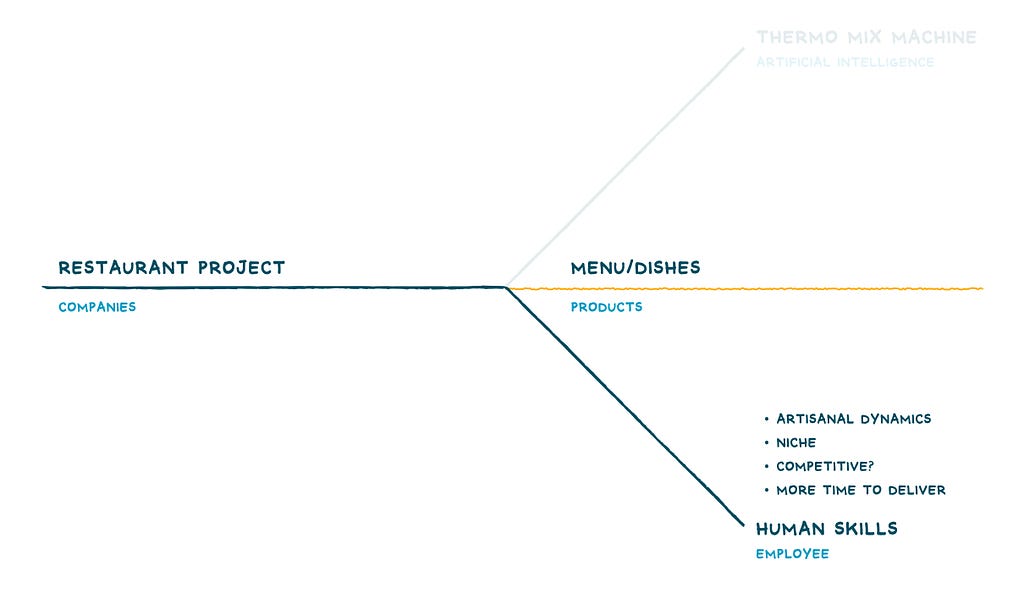
On the contrary, if the person in our story decides not to use the thermo mix machine but instead bets on running a business merely based on craft, you can face results opposite to the case above in terms of money and time.
Possible positive side:
When we talk about creations and originality, this path will be the right one. People’s creativity can amaze us in unthinkable ways; we have witnessed all the delicious meals from people experimenting with an idea. In business, creativity matters because it can drive innovation and disruption, but it is not the only factor to consider when trying to succeed.
Possible negative side:
Creating delicate dishes can put you in an original position relative to competitors and eventually build a reputation, but to stay ahead of the market, you might need to scale your business, refine processes, and maintain a human workforce to support customer demand. Do not get me wrong: scaling a business is not the only way to thrive; take, for example, Jay Fai, a Michelin-starred street-food kitchen in Bangkok, so famous that people wait in long lines for hours for a portion of its food. This recognition is based on years of craft and perseverance, with no sign of being a big food franchise.
In a business, this approach will have consequences, such as time vs. money (unless you are so famous that people will wait for you no matter what). When the time it takes to create your product before delivering it to users is longer than expected, you are at a disadvantage against competitors that offer the same product faster. Being somehow disconnected from technology or automation in business makes you operate on slow, expensive, almost artisanal dynamics.
So, what’s the ideal scenario in which we can partner with high technology while still maintaining something unique, human, and innovative? So here’s the third scenario, which I believe should be the starting point of generating profound changes in the industry.
The new connection value business
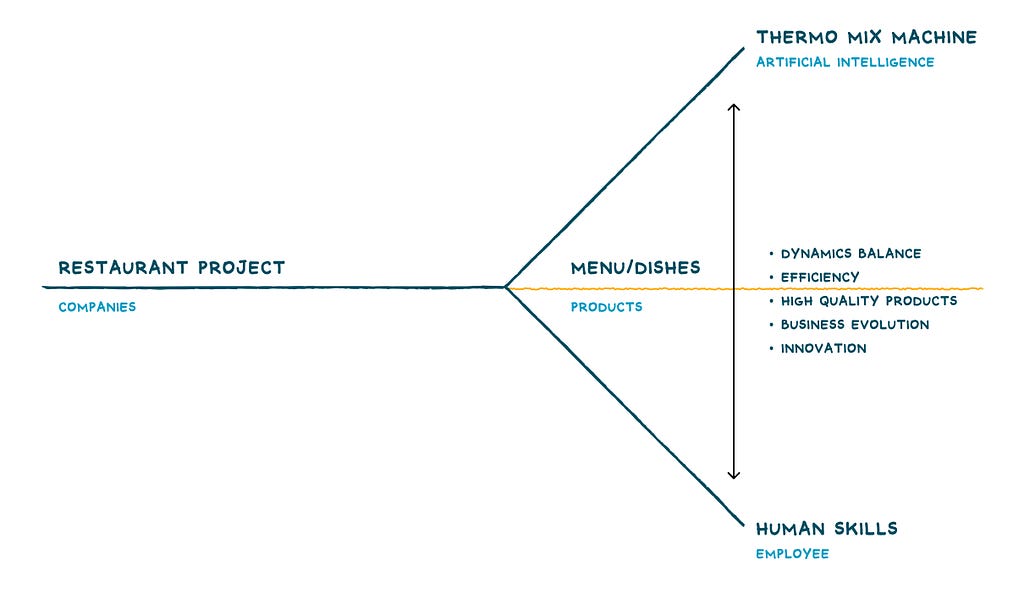
So you decide to take a different approach for your business: this time, the Thermomix machine will handle one production line, while you, on the other hand, start making many unique creations, strategies that complement what the machine does. In addition to this, you decide to create cooking concepts that catch the attention of a new audience for growth, develop services or new products, and, in this model, being fast is one of the many values you can offer customers. The machine work is to develop, and your job is to think in strategy.
This model strikes a balance among maintaining a competitive production chain, achieving scalability, and developing innovative ideas in the market. That combination is the new value that can produce real changes and innovation. Is it the same to use the Thermomix, adding cooking expertise, as to just rely on the machine’s outcome? No, I’m pretty sure results are not the same, and that’s right there, when you realize where your full business potential can be.
In tech companies, this dilemma is evident: some decide to rely solely on AI models or tools, eliminating human skills, and I’m not sure whether the products feel or work the same; they look generic and sometimes have usability or performance issues (it is obvious that there was no human in the loop).
Some companies are still struggling to find that balance and, with it, the value of their products; they prefer to “save money” by letting people leave, but at the cost of lacking the touch — ideas that only a person, not an algorithm, can create.
Put a tool in the right hands, and it will be more efficient than the same tool in the hands of someone lacking vision, skills, and strategy. In a world where anyone can build stuff, your real value now is the ability to apply criteria, knowledge, strategy, and vision to solve problems or uncover business opportunities using advanced tools, not in the opposite direction.
Surviving the future and my thoughts about it:

The Thermo mix story is the face of the near future and of our relationship with it. Today, more than ever, we realize that with the advent of the AI revolution, every day is an experience full of uncertainty and change. But how do we survive this continuous movement within companies? Having a plan for this is impossible, but maybe the only way to surf the wave is to embrace these changes with a more critical view:
- In an era when social media is the most popular form of communication, everyone is fighting for people’s attention, so there is a lot of trash content to get clicks and views. Be critical when finding reliable sources to follow.
- Do not fall into trends without understanding all the benefits and constraints a new model can offer; understanding its functionality and then applying it to your context is more valuable than just being part of the latest technology hype.
- Put the criteria and expertise over tools; it is fine to understand and operate new technology models, but as the person with the Thermo mix, a business is more robust if you find a combination between automation and strategy.
- Surround yourself with people who want to learn and experiment, not “experts” who claim to own the truth of things.
We create the technology of today and tomorrow, but when we learn to view these inventions simply as tools that enhance our creativity, we will be able to explore new paths of progress.
To write this article, I want to credit all the fantastic information sources and other authors who have written about related topics, each from an exciting, different perspective.
AI vs Human: The Intelligence You Forgot You Had
AI Will Not Become Human Until It Has a Shadow
The AI Boomerang Is About To Hit Hard

You’re missing the point; this is your real value in tech companies was originally published in UX Collective on Medium, where people are continuing the conversation by highlighting and responding to this story.
It’s not about a tool or a model, but about your expertise and the criteria that will ultimately enable you to generate profound changes in the industry.Do not fall into trends without understanding all the benefits and constraints a new model can offer.Over the last two years, we have witnessed the biggest tech revolution of the century. We have gone through a spiral of company changes, trends, hype, influencers, misinformation, uncertainty, and massive layoffs, to name a few. These behaviors are “expected” somehow when, as a society, we face such a tremendous change in how we create things, communicate with systems and services, and begin to see our reality with new eyes.The impact of having AI now rooted in our lives has had huge consequences for all of us on many levels. One of these, without question, is the significant influence on businesses that, as any tech revolution does, creates new transactional dynamics between companies, services, and users, as well as new corporate bets that are not always positive for everyone.Along with this new way of connecting people (or should we start saying agents?) with products and services, there is a phenomenon that has led us to lose the real perspective on businesses and human value. As evidence of this problem, the companies that laid off thousands of people in 2025 because of the benefits of the almighty AI tools now seem to regret that decision due to the high costs of tokens and irresponsible usage of AI models; some companies now put in the balance the cost of expending tokens against the full price of an employee, and the numbers do not match. The new market reality is still evolving every day, so what we can be certain about today might be obsolete tomorrow.My reading of this phenomenon (without being, or pretending to be, an expert) is a simple graphic illustrating the inverse relationship between technology (in this case, AI) and human skills that can affect industry realities nowadays.This opposing relationship between humans and tech progress is not new in our history as a society (it is actually part of pop culture, as seen in stories and movies for decades). Still, it doesn’t mean we can’t relate to achieving greater results; that is precisely the point of this article: understanding where the real value to employees lies despite significant technological advancements.A machine that creates everything?Will a business be more profitable if the person who operates the Thermo mix machine could potentially add some strategy to the company beyond just making dishes?In a conversation with a colleague the other day, he gave me an example illustrating the current situation in companies: the dilemma of choosing between people and technology, or between automation and human skills to thrive in business, and, above all, how to measure whether things are going well.The perfect metaphor he used to illustrate this crossroads goes like this: Imagine you could get the Thermomix machine, a smart cooking robot that can literally cook anything for you, so the problem of learning how to cook would be almost nonexistent, and with this advantage, you decide to start a business around this new toy, seeking to thrive in the food market by being faster and more affordable than competitors.So far, with this advantage, some considerations will arise when starting a new commercial venture: no need to hire employees; you already have a complete kitchen production in a single artifact. No recipe limitations: you already have an extensive catalog of options to offer without effort, and without the recipe barrier, there’s no need for a learning path to innovate with unique dishes.Everything sounds promising, doesn’t it? But as usual, nothing in life is granted, and it is always full of nuances. These are the possible scenarios I can predict from that example (not a novelty), which would happen with this situation (I’ll refer to generalities only to illustrate the point):The all-machine businessIn a vast market of options, having a soul, style, or purpose will make you stand out from others.This scenario is pretty much the reality for many companies now; whether big or small, the risk of choosing technology outcomes over human skills can reveal complex challenges as well as benefits. The most evident consequences of this approach might be the following:Possible positive side:As a new business, all initial investment will focus on acquiring the thermo machine to get started; once you have that, you will have almost the entire production chain in one place and under your own operation.All incomes will be yours since you don’t need employees or infrastructure that requires rent. If the business needs customer service, maybe, as a starting point, you can be the same person who operates the machine and delivers.Possible negative side:The thermo machine will indeed do the job, and that’s it. For some people, that will be enough, but to make a name in the food market, having the same product value as hundreds of restaurants with more capabilities will not make a difference. How do you compete in this scenario? Maybe use the time factor, but does your food offer something else that will make people come back?In a vast market of options, having a soul, style, or purpose will make you stand out from others. The same criteria apply to technology: our thermo machine is all the AI models that promise fast results, but they are so generic that anyone can tell the same technology created them, and eventually, our product will vanish and be devalued among hundreds of identical solutions.Will this business be more profitable if the person who operates the Thermo mix machine could potentially add some strategy to the company beyond just making dishes? My answer is in a few paragraphs.The all-human businessWhen the time it takes to create your product before delivering it to users is longer than expected, you are at a disadvantage against competitors that offer the same product faster.On the contrary, if the person in our story decides not to use the thermo mix machine but instead bets on running a business merely based on craft, you can face results opposite to the case above in terms of money and time.Possible positive side:When we talk about creations and originality, this path will be the right one. People’s creativity can amaze us in unthinkable ways; we have witnessed all the delicious meals from people experimenting with an idea. In business, creativity matters because it can drive innovation and disruption, but it is not the only factor to consider when trying to succeed.Possible negative side:Creating delicate dishes can put you in an original position relative to competitors and eventually build a reputation, but to stay ahead of the market, you might need to scale your business, refine processes, and maintain a human workforce to support customer demand. Do not get me wrong: scaling a business is not the only way to thrive; take, for example, Jay Fai, a Michelin-starred street-food kitchen in Bangkok, so famous that people wait in long lines for hours for a portion of its food. This recognition is based on years of craft and perseverance, with no sign of being a big food franchise.In a business, this approach will have consequences, such as time vs. money (unless you are so famous that people will wait for you no matter what). When the time it takes to create your product before delivering it to users is longer than expected, you are at a disadvantage against competitors that offer the same product faster. Being somehow disconnected from technology or automation in business makes you operate on slow, expensive, almost artisanal dynamics.So, what’s the ideal scenario in which we can partner with high technology while still maintaining something unique, human, and innovative? So here’s the third scenario, which I believe should be the starting point of generating profound changes in the industry.The new connection value businessThat combination is the new value that can produce real changes and innovation.So you decide to take a different approach for your business: this time, the Thermomix machine will handle one production line, while you, on the other hand, start making many unique creations, strategies that complement what the machine does. In addition to this, you decide to create cooking concepts that catch the attention of a new audience for growth, develop services or new products, and, in this model, being fast is one of the many values you can offer customers. The machine work is to develop, and your job is to think in strategy.This model strikes a balance among maintaining a competitive production chain, achieving scalability, and developing innovative ideas in the market. That combination is the new value that can produce real changes and innovation. Is it the same to use the Thermomix, adding cooking expertise, as to just rely on the machine’s outcome? No, I’m pretty sure results are not the same, and that’s right there, when you realize where your full business potential can be.In tech companies, this dilemma is evident: some decide to rely solely on AI models or tools, eliminating human skills, and I’m not sure whether the products feel or work the same; they look generic and sometimes have usability or performance issues (it is obvious that there was no human in the loop).Some companies are still struggling to find that balance and, with it, the value of their products; they prefer to “save money” by letting people leave, but at the cost of lacking the touch — ideas that only a person, not an algorithm, can create.Put a tool in the right hands, and it will be more efficient than the same tool in the hands of someone lacking vision, skills, and strategy. In a world where anyone can build stuff, your real value now is the ability to apply criteria, knowledge, strategy, and vision to solve problems or uncover business opportunities using advanced tools, not in the opposite direction.Surviving the future and my thoughts about it:Put the criteria and expertise over tools!The Thermo mix story is the face of the near future and of our relationship with it. Today, more than ever, we realize that with the advent of the AI revolution, every day is an experience full of uncertainty and change. But how do we survive this continuous movement within companies? Having a plan for this is impossible, but maybe the only way to surf the wave is to embrace these changes with a more critical view:In an era when social media is the most popular form of communication, everyone is fighting for people’s attention, so there is a lot of trash content to get clicks and views. Be critical when finding reliable sources to follow.Do not fall into trends without understanding all the benefits and constraints a new model can offer; understanding its functionality and then applying it to your context is more valuable than just being part of the latest technology hype.Put the criteria and expertise over tools; it is fine to understand and operate new technology models, but as the person with the Thermo mix, a business is more robust if you find a combination between automation and strategy.Surround yourself with people who want to learn and experiment, not “experts” who claim to own the truth of things.We create the technology of today and tomorrow, but when we learn to view these inventions simply as tools that enhance our creativity, we will be able to explore new paths of progress.To write this article, I want to credit all the fantastic information sources and other authors who have written about related topics, each from an exciting, different perspective.AI vs Human: The Intelligence You Forgot You HadThe AI Industry Is PanickingAI Will Not Become Human Until It Has a ShadowThe AI Boomerang Is About To Hit HardYou’re missing the point; this is your real value in tech companies was originally published in UX Collective on Medium, where people are continuing the conversation by highlighting and responding to this story. UX Collective – Medium